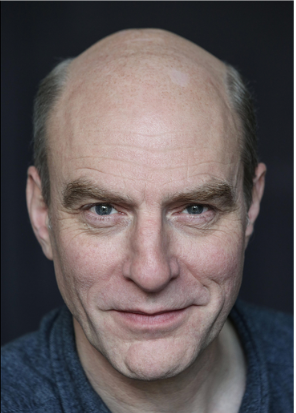
No Plan B: What 40 Years in British Film and Theatre Actually Teaches You
Simon Kunz has been working continuously in British theatre and screen since the early 1980s — without ever going to drama school. Four Weddings and a Funeral, GoldenEye, Captain America, The Last Kingdom. Here is what he told Ukrainian actors about rhythm, confidence, being seen, and why you have to consume the work before the work will consume you.
Simon Kunz
Actor · London · 40+ years on stage and screen
UK Market
About this session
40+Years working in British film and theatre
1982First professional work — no drama school
2026First day back in theatre — exactly 6 years after COVID closed the stages
"You have to love it. Not quite like it — love it. It's got to consume you."
01 · The Beginning
Drums First. Then Acting. Then a Very Clear Choice.
Simon Kunz grew up with music in his blood — his grandfather was Charlie Kunz, one of Britain's most famous popular pianists, a household name in the UK from the 1930s through the 1950s. Simon became a drummer, was in bands at university in the early 1980s, and could have gone that way.
He chose acting instead — not because he was certain, but because he was honest with himself about which thing he was better at.
"I'm an alright drummer. But I think I can act better than I can drum. So."
— Simon Kunz
What he took from drumming — and still talks about as central to everything he does — is rhythm. Not as a metaphor, but as a practical tool. Good writing has good rhythm. Comedy is entirely about rhythm. Dramatic scenes hit harder when the timing is right. The relationship between music and acting never left him.
He did not go to drama school. He did a Theatre Studies degree at the University of Warwick — academic, not vocational, focused on history and practitioners. He learned how a theatre building works, lit shows, built sets, made costumes, directed, acted. Then he formed his own theatre company, got seen, got his Equity card as an understudy on a touring production, and built from there.
This session took place on 19 March 2026 — which Simon noticed, mid-conversation, was exactly six years to the day since theatres closed for COVID on 19 March 2020. That morning had been his first rehearsal day back on stage in six years. A Euripides play — Iphigenia at Aulis — with Simon playing Agamemnon.
02 · Theatre vs Screen
What the Stage Gives You That Screen Cannot
Simon has done both throughout his career — theatre at the National, Bristol Old Vic and small fringe stages; screen across decades of film and TV. His view on the relationship between the two is one of the richest parts of this conversation.
"Theatre is petrol. It feeds you. It's like going to the gym. And it gets you seen."
— Simon Kunz
🎭
Confidence above everything
Theatre builds a particular kind of confidence — not personal confidence, but confidence in the work. The confidence to sell a character to a room of strangers every single night, whether or not you feel ready.
🎥
The rehearsal advantage
Theatre gives you weeks to explore. Film rarely gives you more than the morning. The flip side: that first fresh take on film can be magical in a way a well-rehearsed stage moment can never quite replicate.
📐
Space works differently
On stage, your whole body is visible to the audience from all angles. On camera, the director decides what they see. Being aware of which space you're in, and working with it rather than against it, is fundamental.
⚡
Improvisation captured vs. recreated
In film, when you find a great spontaneous moment it's in the can forever. In theatre, you have to try to find that electric moment again every night — which is the hardest and most beautiful thing about it.
He is clear that the transition between stage and screen is not as difficult as people think. The technical adjustments — working within the frame, understanding how close or far the camera is — are common sense once you know about them. The deeper skill transfers directly.
On "theatrical" film performances: Simon notes that sometimes a deliberately big, theatrical performance on screen works brilliantly — even when directors have asked for naturalism. The rule is not size but truth. If it's true, it can never be too big.
03 · The British Market
How the British Industry Actually Works — and What You Need to Break In
Simon was refreshingly honest here: as a British actor who has always worked in Britain, he doesn't fully know what it's like from the outside. But he knows the fundamental mechanics — and they're the same for everyone.
"You might be the best actor in the world — but if you're not seen, who gives a damn? Nobody is going to come and find you."
— Simon Kunz
The British industry is centred on London. That's where the majority of castings, agents, and productions are based. His partner Caroline has just finished a run at the National Theatre in a play called The Land of the Living, which included several Ukrainian actresses now based in the UK — proof that it is being done, and being done successfully.
Getting an Agent — The Catch-22 and How to Break It
The classic problem: it's hard to get an agent without credits, and hard to get credits without an agent. Simon's path — forming his own theatre company, touring festivals, getting seen in fringe theatres, being picked up by an agent who came to see a show — is still valid, and still the most reliable route.
1
Get into something you can be seen in
A play. Even a very small one. Even unpaid. The point is to be in front of people who matter. Write to casting directors and agents and invite them. Most will say no. Some won't.
2
Build a showreel
If you can't get professional credits yet, make pieces specifically for the reel. Get it in front of agents and casting directors. A good reel from an unknown production outweighs a bad clip from a famous one.
3
Fringe theatre is not a step below — it is the step
Simon got his first agent from a fringe production. Good agents actively scout small theatres looking for talent. The Barbican and the National weren't the entry point. The fringe was.
4
Drama school showcase route
If you go to a top UK drama school, agents and casting directors attend the end-of-year showcase. It is one of the most direct paths into representation. Not the only one, but the most structured.
Honestly, yes — if you want to play roles that aren't defined by your origin. If you can work on a neutral or American accent to a convincing level, the range of what you can audition for increases significantly. Simon pointed out that American English might actually be the more useful target, because there's simply more American content being made than British. That said, Ukrainian actors are working in UK productions right now — Simon's partner worked alongside several. The key is being in the country, being visible, and building relationships. The accent question comes second.
Simon is living proof you don't. He had no drama school training and has worked continuously for 40 years. What matters far more is whether you can do the work, whether you're easy to work with, and whether you're visible. That said, he acknowledges the path is harder now without formal training than it was in the early 1980s. Drama school gives you structure, community, and — crucially — the showcase at the end. If you can get into a good school, it's worth it.
Simon's advice: get as good as you possibly can where you are. Do everything. Form a company if you have to. Work in your own language, with writers and directors who push you. And work on your English on the side — not as the main goal, but as a parallel project. When the opportunity comes to make a move, you want to already be a serious, formed actor — not someone who is still developing their craft while also trying to navigate a new industry in a new country.
04 · Preparation
How Simon Prepares — From the Word Outward
Simon describes himself as someone who works from the text outward — from the word, to the meaning, to the rhythm, and eventually to the emotion and the body. This is the reverse of some approaches, and he's clear it's not the only way. But it's his way, shaped by his love of poetry and language.
1
Research the world
If it's historical, read around it — Chaucer for a 14th century peasant revolt, Euripides in translation for Greek tragedy. If it's a junkie in modern Kyiv, find out what that life actually looks like. Steep yourself in the world before you think about the character.
2
Carry the script everywhere and mutter constantly
Learn lines by walking. Movement helps them settle in the body, not just the head. Lie in the bath with the script. Cook dinner with the script. The goal is to forget you've learned them — so they're just there, automatic, and you can be alive in the scene instead of thinking about words.
3
Find the rhythm
Good writing has good rhythm. Simon reads and re-reads text looking for it — where the pulse is, where to land a word, where the pause does the work. This is where his musical background comes in most directly.
4
Think about what you look like and how you move
Costume matters to him. He thinks about it early. And he walks around as the character — physically inhabiting their posture before he's ever in the rehearsal room. Agamemnon doesn't slump. So he stops slumping on his walk through the park.
5
Find what is you and what is not you
What does this character share with how you actually are? Where do you need to add something, or take something away? The overlap is where your strength is. The gap is where the creative work happens.
6
Stay open — your ideas will get demolished, and that's right
You arrive with what you think are good ideas. The director has other ideas. The other actors have different rhythms. Half your preparation gets thrown out in the rehearsal room. That's not failure — that's collaboration. Stay open to it.
"Acting is problem solving. You've got a scene to perform. That's your problem. Solve it."
— Simon Kunz
05 · Auditions
You Are Their Solution. Not the Other Way Around.
One of the most useful reframes in the entire session. Simon described the shift in thinking that transformed how he approached auditions — from going in desperate and frightened, to going in as an equal.
"They have a problem. Their problem is they have a part that needs filling. You are their solution. Go in and offer them that."
— Simon Kunz
This isn't arrogance. It's a practical recalibration of the power dynamic. Once you stop thinking "I need this job" and start thinking "they need someone for this role, and I might be that person," the conversation in the room becomes easier. You can ask them questions. You can be curious about what they're making. You stop being a frightened actor and start being a professional.
💬
Ask them questions too
They're not there to grill you. They're looking for someone to solve their casting problem. Ask what they've been working on. Open the conversation. You don't have to sit there answering questions the whole time.
✨
Your uniqueness is useful
You have a unique sound, rhythm, humour, look. Everything about you is distinctive. That distinctiveness is not a barrier — it is the thing that makes you castable in a way nobody else quite is.
📚
Learn the bloody lines
He said this plainly and repeatedly. The more work you put in, the better you are. It is an old adage because it is simply true. Do not be lazy.
🎯
Know the tone
A Marvel superhero film has Shakespearean scale. A naturalistic drama needs stillness and connection. Knowing what kind of piece you're auditioning for shapes every choice you make in the room.
06 · Saying No
The Only Control You Have Is the Power to Refuse
A participant asked whether Simon ever turns down work — and why. His answer was unexpectedly honest about the psychology of it.
"The only control you have in this industry is to say no to a job. And sometimes I've said no and felt like a million dollars afterwards — even though I wasn't getting paid."
— Simon Kunz
His reasons for saying no have evolved over 40 years. Early on, he rarely did — and he wouldn't recommend it to younger actors either. Do everything you can. Every job is experience. Early in a career, the cost of turning work down is almost always higher than the cost of taking something mediocre.
Two reasons. First: if he has money in the bank and can afford to wait. Second — and more interesting — typecasting. The only control you have over how you're perceived is the roles you accept. If you keep playing policemen and lawyers, you become the policeman and lawyer actor. Saying no to the safe, familiar role — even a lucrative one — is sometimes how you make space for the part you actually want. Simon has done it. He waited, and the other parts came.
His father, who is now gone, always said: just work. Keep working, no matter what. And Simon thinks there's real truth in that — especially when you're young. But there is also a point where your gut tells you this particular job adds nothing, and then you have to listen to that too. The practical advice: when you're starting out, take almost everything. As you get more established, start listening to whether anything about a project actually excites you. If the honest answer is no, and you can afford to wait, wait.
07 · UK Drama Schools
Where to Train in Britain — and What Simon Actually Thinks of Drama School
Simon didn't go to drama school himself — he was suspicious of the competitive environment and the tendency to work on fragments of plays rather than complete parts. He learned by doing whole plays in front of real audiences. But he acknowledges the landscape has changed, and he recognises the value of formal training for people coming in from outside the British system.
UK Drama Schools Simon Mentioned
→
RADA — Royal Academy of Dramatic Art, LondonThe most famous name in British drama training. Founded 1904. Three-year BA in Acting. Extremely competitive. One of the most internationally recognised acting conservatories in the world.
→
LAMDA — London Academy of Music and Dramatic ArtFounded 1861 — one of the oldest drama schools in the world. Alumni include Benedict Cumberbatch, David Oyelowo, Ruth Wilson. Simon mentioned this alongside RADA as one of the schools with real weight behind it.
→
Guildhall School of Music and Drama, LondonSimon noted this is particularly strong if you also have musical ability. Ranked number one in Arts, Drama and Music by the Complete University Guide 2025. Alumni include Ewan McGregor, Orlando Bloom, Lily James.
→
Royal Central School of Speech and Drama, LondonKnown as "Central." One of the UK's leading drama schools, part of the University of London. Strong reputation for classical and contemporary work.
→
East 15 Acting School, LondonSimon mentioned this as offering a more Stanislavski-based approach — closer to what you might call the method tradition. Part of the University of Essex. Very international student body — actors come from over 20 countries to train there.
→
Drama Studio LondonMentioned alongside East 15 as a school with a reputation for a more emotionally grounded, Stanislavski-influenced approach. Located in West London.
Simon's honest view on drama school: He watched people go to drama school at university — brilliant, alive, full of energy — and come out "cowed and broken." The process of being taught to act can sometimes strip away the very confidence that made someone interesting in the first place. His counterargument: do whole plays, in front of real audiences, as much as you possibly can. That is the real training. The feedback is immediate — are they laughing when they should laugh? Are they silent when you need them silent?
08 · Advice
The Worst Advice, the Best Advice, and Michael Gambon Driving to Stratford
The worst advice Simon ever received came from the head of Equity — the UK actors' union — when Simon was 18 or 19 and desperately wanted his Equity card. The man looked at him and said: maybe you should just be an amateur actor. Go and do plays in church halls.
"That spurred me on. How dare you sit there in your power and tell me I don't really want to be an actor. No. Fuck you. I'm going to do it."
— Simon Kunz
The best advice: no Plan B. Not as a cliché, but as a genuine commitment to the work itself — not to fame, not to money, but to the privilege of saying the words of great writers.
He told a story about Michael Gambon — the British actor known internationally from the Harry Potter films, who died in 2023 — driving up the motorway from London to Stratford-upon-Avon to play King Lear at the RSC in 1982. Gambon looked across at the car next to him: a businessman in a shirt and tie, jacket hung up neatly behind him. And Gambon thought to himself: those people don't know they're living. I'm going to play King Lear.
"That's all the payment you need. And I know that sounds naff. But if you start with that attitude, I think the rest will come."
— Simon Kunz
The Final Things He Said
🔥
It has to consume you
Not something you quite fancy doing. Not a career you're pursuing because you're good at it. If you can take it or leave it, leave it. If you can't imagine not doing it, that's the thing.
🤝
Respect every single person on the job
From the highest to what you might think is the lowest. Everyone on a film set is critical. Be difficult or rude to the wrong person and word travels fast in a small industry.
🌿
Fail. Fail again. Fail better.
Samuel Beckett. There is no perfect play, no perfect film. You will always find something you'd do differently. That is not a reason to stop. It is the condition of the work.
🎭
Acting is a kind of therapy
It lets you put your demons somewhere useful. Great art — a painting, a play, a film — makes people feel less alone. It shows them their own emotions from the outside. That is what you are trying to do every time you work.
He ended by offering something practical and personal: to connect the group with Ukrainian actresses now working in London through his partner's National Theatre production, who could speak to the experience of making the move from the inside.
Join the Next Mriia Mentors Session
Free live Q&A sessions with working actors, directors, and casting professionals from the UK, US, Spain, Germany and beyond. Open to Ukrainian film and theatre artists at any stage of their career.