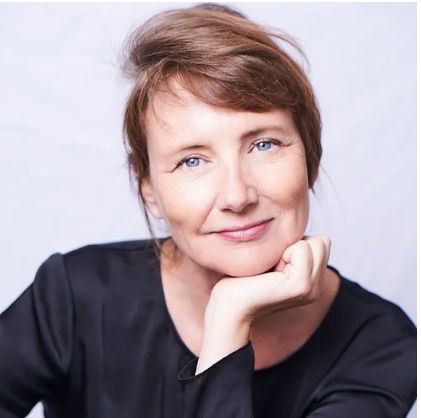
Less Is More: A Script Editor and Screenwriter on Craft, Adaptation, and Surviving the Industry
Lucy Shuttleworth started her career at Miramax London reading The Usual Suspects on a motorbike courier delivery and faxing the report back. She went on to script edit, head development at a Brighton production company, work on The Merchant of Venice with Al Pacino and Jeremy Irons, and write and associate produce The Secret of Moonacre. In this Mriia Mentors session she talked about everything that actually matters: craft, character, less dialogue, the suit of armour you need to survive, and why you must come to the desk every day even if you only write your name.
Lucy Shuttleworth
Screenwriter, Script Editor and Educator · Brighton, UK
UK · Craft
About this session
MiramaxFirst script read: The Usual Suspects
PacinoThe Merchant of Venice · Jeremy Irons · Joseph Fiennes
MoonacreWrote and associate produced The Secret of Moonacre (2008)
"Writers are like moles who live underground and don't like to come out. But you have to. Finish the draft. Show it. Come back and write the next one."
01 · Career Path
She Read The Usual Suspects First. Five Times, Because She Was Confused.
Lucy Shuttleworth studied Drama and English at university, worked in children's book publishing, did fringe theatre in London, and had a baby in her twenties. The combination of circumstances led her to someone who was setting up a company in London for Harvey Weinstein called Miramax. She'd been working in children's publishing, they needed someone to research children's books for adaptation, and she was hired.
They liked the way she wrote reports. They asked if she'd like to read a script. The first script she ever read was The Usual Suspects. She read it about five times. She was very confused by it, but she thought: this is something I love more than publishing, more than trying to make it as an actress. In those days, a courier would arrive on a motorbike with a script, she'd read it and fax over the report. The scripts were extraordinary. Trainspotting, Breaking the Waves, The Usual Suspects. A golden age of filmmaking, whatever else was happening behind the scenes.
"The scripts I read were amazing. Trainspotting, Breaking the Waves, The Usual Suspects. I learnt my craft reading scripts. I really enjoyed it. Writing detailed reports, having an opinion. And I thought, this is something I love more than anything I've done before."
Lucy Shuttleworth
From Miramax she worked freelance as a script reader, then a script editor. A producer who had worked on The Usual Suspects read one of her reports and told her she was a natural script editor. She started script editing projects, working with writer-directors, producing alongside, learning from every collaboration. She moved from London to Brighton, where she still lives.
In Brighton she was recommended as head of development to a production company by a director she'd worked with. She took the role. It was the 2000s, more money was in the industry for development and production, and she was doing everything: reading scripts, employing script readers, working with directors, attaching cast, working post-production. One of the biggest films they made was The Merchant of Venice with Al Pacino, Jeremy Irons and Joseph Fiennes.
All along she wanted to write. She'd been writing since university, written things that hadn't happened. Then she found a book she had always wanted to adapt — The Little White Horse by Elizabeth Goudge. Her bosses said she could option it if she did it in her own time. She got up at 5am with two children, wrote before the day started, found out about the rights, and slowly built what would become The Secret of Moonacre (2008), directed by Gabor Csupo. She wrote it and associate produced it, though she says she was doing considerably more producing than her credit suggested — going to America to raise money, attaching people, driving the project forward obsessively for years.
On being uncredited for producing work: Lucy was doing significant producing work on Moonacre without being properly credited for it. She mentions this without bitterness, as a simple fact of how the industry works, particularly for women. It came up again in her broader points about how the industry still requires women to work harder to receive equivalent recognition.
02 · Getting Films Made
It Is a Process of Attachments. And It Is a Lottery.
Julia asked the question every writer wants answered: how do you know a script will actually get made? Lucy's answer was direct. You don't, and it doesn't work like that.
She had just come back from the Berlin Film Festival when this session took place, and she was reminded there of something she describes as the nature of the industry: sleight of hand, one meeting, one conversation can change everything. She has been involved in films that had no business getting made because money appeared. She has seen scripts that weren't ready go into production. She has seen projects collapse at the last moment when a director got a better offer or an actor dropped out and the finance followed.
"Making a film is a process of attachments. You get a director who is financiable. Then it starts building. But the director might then go to a Hollywood movie. The actor drops out. The finance drops out. Your project doesn't happen. It is a lottery. But keep at the script. Everything is the script."
Lucy Shuttleworth
Her framework for what gets made is based not on the quality of the script alone but on the accumulation of the right people around it at the right moment. Pitching first to agents to get directors. Getting a director who is financiable attached. Building from there. The script must be the best it can possibly be, because without that nothing else sticks. But the script is necessary, not sufficient.
🤝
Work with people you trust
When things fall apart for reasons outside your control, the team around you is everything. Working with great people who share your values and your creative instincts makes the difficult moments survivable.
🎯
Great stories have veracity
Truth is what makes great stories resonate. Even uncomfortable truths. We believe in them. In the same way we play certain songs over and over, great writing speaks to something real about the human condition that resonates beyond the screen.
🚪
Keep knocking at the door
One of the directors she worked with said it simply. If no one answers, do not be too downcast. Knock again. Something will happen. The industry is a lottery, but determination changes the odds over time.
⚡
AI creates sameness: avoid it
She raised AI without being asked about it. Her concern: everything becomes anodyne when AI does the creative work. All great things have imperfections. What an audience responds to is originality and passion — the thing that makes them think: I want to watch that.
03 · Adaptation
You Have to Paint a Picture. Not Write One.
Lucy has adapted several books for the screen, including The Little White Horse by Elizabeth Goudge which became The Secret of Moonacre, and a number of other best-selling novels that haven't yet been produced. Her advice on adaptation is grounded in everything she has learned from those projects.
1
Be aware of the readership
If there is a large existing audience for the book, they have a relationship with it. You have to understand that and respect it. You are not just adapting a story, you are adapting someone else's beloved work, and the people who love it will be watching.
2
Understand that a film is a different beast to a book
Every single word the author wrote is not going to be in the film. Characters will be cut. Scenes will be condensed or removed. This is not a failure of the adaptation. It is a requirement of the form. The film must work in its own right in its own time.
3
Keep to the integrity of the intent
The specific things that can be changed are infinite. What must be preserved is the essential intention of the original work. What is this story fundamentally about? Stay true to that and you can make enormous structural changes without betraying the source.
4
Don't try to make it literary
Films are visual. You are telling the story through what people see and do, not through interior monologue or descriptive prose. Paint a picture rather than write one. That is the crucial shift from literary to cinematic thinking.
5
Start with an extended synopsis
Before the treatment, read the book and write out everything in your own words. Work out what you want to keep and in what order. Think about where to start the film. Do you begin at the beginning of the book? At the end and work back? The synopsis is the thinking, not the planning.
"The mistakes are trying to include everything, and trying to make it more literary. Films are visual. You've got to paint a picture rather than write a picture."
Lucy Shuttleworth
04 · Process and Structure
Beat Sheets, Sticky Notes, and the Google Maps Approach to Treatment
Lucy does not do a scene-by-scene breakdown before writing. What she does instead is a beat sheet: working out the act structure and the overall shape of the story before the writing begins. She is currently writing an original script and described her process: a noticeboard with sticky notes in capital letters, reminders shouted at herself, script notes written directly into the document as she drafts.
She was part of a screenwriting group that included William Nicholson, who co-wrote Gladiator, and Robin Slovo, one of the most successful female screenwriters working in British television. Slovo's approach to a treatment was revelatory to her: Slovo writes treatments that read like small novels, sometimes 80 pages long, immersing herself in the world before writing a word of the script. It was a reminder that every writer has a different process, and none of them is universal.
"A treatment is like Google Maps before you go. You look, you know roughly where you're heading, but you might go a completely different way once you start. It gives you a rough shape. It is not a rigid route."
Lucy Shuttleworth
🗺️
Treatment as Google Maps
Know where you are going before you start, but do not mistake the map for the journey. The treatment will change massively once writing begins. Be open to that. Rigidity in a writer creates its own set of problems.
📋
Beat sheet before scene breakdown
Lucy works out the act structure and the key story beats before writing. Not scene by scene, but a clear structural shape. For writers working with producers on contract, this also protects both parties when creative direction is discussed.
📌
Noticeboard with sticky notes
A physical or visual representation of the story's shape helps her hold the whole thing in view while writing individual scenes. Notes in the script itself, reminders in capitals, keeping the bigger picture present while working in the detail.
📖
Robin Slovo's 80-page treatments
Some writers go deep before the script. Slovo writes treatments that function as small novels, completely inhabiting the world before touching the screenplay format. Knowing this exists as an approach gave Lucy permission to take as much time in the preparation as she needed.
Recommended reading:Into the Woods by John Yorke. Lucy calls it a really good scriptwriting book. Yorke is very smart on story structure, and his idea of characters as avatars that the audience steps into and sees through changed how she thought about point of view. Seeing everything from the character's perspective, especially for characters who are difficult or badly behaved, is one of the most important skills a screenwriter can develop.
05 · Less Is More
Guillermo Arriaga Cut Five Pages to Three Sentences. He Was Right.
Lucy attended a masterclass by Guillermo Arriaga, the Mexican screenwriter who wrote Amores Perros, 21 Grams and Babel. He described a scene in his first film where a woman leaves. He had written five pages for it. The director reduced it to three sentences: she comes to the door, she puts a note through, she leaves. Arriaga was furious. Then he watched it back, and understood. It was more powerful.
"Films that really work have depth. There is silence in between. As writers, we overwrite, and then we take a lot of it out, because we have said too much. Audiences are smart. You don't need to list all the reasons someone is leaving. Sometimes a door closing is stronger than anything you could write."
Lucy Shuttleworth
Her principle from this: write everything, then remove most of it. The first draft is about getting it all out. What remains after editing should be only what cannot be conveyed without words, and only the minimum of that. Audiences are intelligent and imaginative. They fill the silence. They do not need every thought explained.
She referenced a book called The Breath in Cinema — the space in between. For her, the films that stay with an audience are the ones that leave room. Trusting the viewer is not a risk. It is a form of respect, and it is dramatically more powerful.
The visual metaphor principle: Lucy teaches this directly. One of her ex-bosses was not a kind man. When they were going to a film festival together to have their passes photographed, he drove to the supermarket and parked in the disabled bay. In his Maserati. She made him move. But she uses him constantly as a teaching example: that single action, without a word of dialogue, tells you everything about who this person is. That is visual storytelling. What can your character do, rather than say, that reveals who they are in an instant?
06 · Script Editing
The Script Editor's Job Is to Support the Writer. Not to Remove the Text.
Lucy is clear and emphatic on this. A script editor never removes a writer's text. The job is to support the writer, to be the go-between with the producer and sometimes the director, and to ask the questions that help the writer deliver the best possible version of their script.
In practice she reads the script and writes a series of notes. Some writers prefer recorded calls where she talks through the notes and they are captured that way. The approach depends on the experience of the writer and what the producer is asking for. What she always focuses on first is the bigger structural points: what is working, what is not, what can be done about it. Not line-by-line notes on a first pass, but the question of whether the story is functioning as a whole.
🌱
Build confidence, don't destroy it
A writer who loses confidence in their own work will lose the voice that made the material interesting in the first place. Script editing that is harsh or dismissive has a bad effect even when the notes are technically correct. The writer has to feel it is still their work.
💡
Make suggestions, not demands
She might say: the emotional resonance of this character doesn't land because we don't know enough about them yet. If you need a death, maybe it should be someone closer to the protagonist so it carries the weight you're trying to give it. That is a suggestion, not a rewrite.
🎯
Protect the writer from the room
Not everyone giving notes on a script is script-savvy. Distribution people, financiers, people with a stake in the project but no creative instinct, all have opinions. Part of the script editor's job is to filter what reaches the writer and to help them know which battles to fight.
🏆
Good script editors don't get credit
If they are doing the job well, the writer's name is on the script and the script editor's name is invisible. That is how it should work. The credit belongs to the writer. The script editor's job is to help the writer be as good as they can be.
"The best note I ever received was someone asking: what is this story ostensibly about? And the script went from there to there. Everything became clear. One question."
Lucy Shuttleworth
This was said about the script executive from Toy Story who she met in LA while writing Moonacre. One question, one conversation. The script transformed. She did not share the specifics of the note itself, but the principle is the one she has carried ever since: the most powerful script notes are not about details. They are about essence. What is this story fundamentally about?
On bad notes: The worst notes come from people who reference other films. She was given extensive notes by a distribution person that reduced to: that's like E.T. You don't want to replicate what has already been done. Notes that compare your work to existing films rather than engaging with your story on its own terms are almost never useful. When you receive them, you have to find a way to say no while keeping the relationship intact.
07 · Inspiration and Process
Come to the Desk Every Day. Even If You Only Write Your Name.
Raymond Chandler said it. Lucy quotes it as the most reliable single piece of writing advice she has found. Come to your desk every day. Even if you write your name and underline it five times. You came. Tomorrow you might have five words. But the habit of showing up is what makes writing happen over time.
🎨
Go to a great art gallery
Step out. Go somewhere rich and visual. See what someone made and marvel at it. Inspiration comes from other forms of creativity, not just from other films. The reminder that extraordinary things get made by human beings is itself energising.
🎵
Write with music
Lucy writes with different music for different scripts. Sometimes she has the music of the film in her head already. Music helps create characters. It shapes tone. It changes the emotional register of a scene while she is writing it.
🎬
Watch films as research
If you are stuck, watch films in the genre or with the tone you are trying to find. You cannot write well for film without watching a great deal of film. Watching is not procrastination when it is done intentionally. She watched many French films and learned from them how conflict over a dinner table can reveal everything about a set of characters.
👁️
Go out and watch people
Characters appear in real life. On trains, in parks, wherever people are being themselves without awareness of being observed. Writers have to be nosy. The detail of how a real person moves, speaks, reacts to a small difficulty, is the material that makes characters live on the page.
"Be kind to yourself. Writers are very good at beating themselves up. Put a big sticker on your head: I am not going to be horrible to myself today. And then watch films all day if that is your research. Come back when you are ready."
Lucy Shuttleworth
She also spoke about clothing as a writer's tool for character. She is currently writing a supernatural script where the way people dress is a visual metaphor for something strange happening in the town. Clothes are one of the most immediate ways to tell an audience who someone is before they speak. She teaches it directly. Sometimes, she says, a character you are writing turns out to be someone you know, and you realise that is why the dialogue is just popping, just coming naturally, because you know exactly how they talk. Noticing that, and being honest about it, is part of the craft.
Recurring themes in her own work
Iris asked whether she noticed themes that keep returning. Lucy's answer was immediate: she always writes about photographers. She is interested in the way the camera as a device allows you to show information differently. Looking through a lens at the world rather than being in it is a recurring way of exploring characters who are somehow separated from direct experience. She is also drawn consistently to the female perspective, to stories that challenge the patriarchy through narrative rather than through argument, and to drama-comedy, because she believes life is fundamentally absurd and that the only way to really get through it is to find the comedy in it.
08 · Surviving the Industry
Wear a Suit of Armour. And Learn to Mourn.
Julia asked what qualities the writers she has worked with and respected most have shared. Lucy's answer was the one that no one wants to hear but everyone needs to: resilience, above everything else. A suit of armour.
"Your script has to be the best it can possibly be. And then things happen that are outside your control. The director drops out because they've been offered a Hollywood film. The actor drops out, the finance drops out, your project doesn't happen. You have to mourn it. And then you have to keep going."
Lucy Shuttleworth
She described the experience of a project collapsing as being like a relationship ending. It requires mourning. It requires time. And then it requires picking up and starting again, because if you are really a writer there are always characters running around your head waiting to be let out onto the page, and it is hard to stay down for very long.
Lucy started at Miramax under Harvey Weinstein in the 1990s. She says the industry was so sexist then. It is still tough for women. Tokenism is real. There is still the sense that having one woman in the room is sufficient. Women have to work harder, which is annoying because it is already hard. But she says it clearly: keep on knocking at the door. Knock again. Something will happen. The situation is changing, even if not fast enough.
Writers tend to live underground, not wanting to show their work, endlessly rewriting the same draft for years without showing anyone. You cannot do this. You have to finish the draft, show it to people, and come back and write the next one. The drafting process only works if you complete the drafts and move them through the world. Sitting on something until it is perfect is not a strategy. It is avoidance.
She used the image of Penelope in the Odyssey, weaving her loom every night and undoing it every day so she would not have to marry one of the suitors. That is the writer who never finishes anything. You have to get to the end of your weaving and show it. Then start the next piece. The pattern of finishing, showing, and beginning again is what a writing career is actually made of.
Lucy is part of a women writers group in Brighton, including writers for film and TV as well as producers. They read each other's work in a supportive environment. Finding your people matters. Writers are sensitive, and if you show your work to someone who will be brutal before you are ready for that, the damage to your confidence and your relationship with the material can be lasting. Choose carefully who you show things to and when.
Her top practical advice, said last and said with conviction: go to networking events. Go out and meet people. One conversation can change everything. When she was head of development she would receive approaches and sometimes forget to respond. Someone who sent a follow-up email often got an answer: actually yes, we are looking for something like this, send it in. Be persistent. Be determined. Keep at it. And send the follow-up email.
Join the Next Mriia Mentors Session
Free live Q&A sessions with screenwriters, producers and industry professionals from the UK, US, Spain and Germany. Open to Ukrainian filmmakers and writers at any stage of their career.