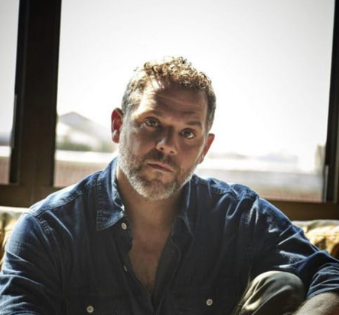
The Skin of an Elephant, the Heart of a Lion: What It Actually Takes to Work as an Actor in the US
Joshua Bitton has been working in New York and Los Angeles for over two decades — HBO prestige drama, network TV, film, and now Broadway and co-founding the Ojai Theatre Festival with Jon Bernthal. In this Mriia Mentors session, he shared everything Ukrainian actors need to know about breaking into the American market.
Joshua Bitton
Actor · New York & Los Angeles · MFA Rutgers University
US Market
About this session
20+Years working in New York & Los Angeles
MFARutgers University · Meisner technique
2025Launched Ojai Theatre Festival with Jon Bernthal
"As an actor you need the skin of an elephant, the heart of a lion, and the patience of an angel. Not one or two of those — all three."
01 · The Beginning
First Jobs: Children's Theatre, Yogi Bear, and the Lesson That Stuck
Joshua's first paying theatre job was a children's theatre tour about slaves escaping north during America's slavery era. They toured the northeast, including deeply rural areas — places where some families openly held white supremacist views and had told their children that slavery was a myth. The experience shaped his understanding of what theatre could actually do in the world.
His first television job was a commercial for the Cartoon Network. He played a security guard who got into a fight with Yogi Bear after the cartoon character forgot his ID. He made about $250 a week from the tour and was thrilled.
"I'm usually a better person when I'm acting than when I'm not. For most actors, that's true — and finding avenues to keep doing the work is what it's all about."
— Joshua Bitton
He studied at Rutgers University's Mason Gross School of the Arts — one of America's most respected MFA acting programs, which grew from the same William Esper / Meisner tradition that would later shape his own teaching. The program regularly showcases graduating actors for agents and casting directors, which is part of how he built his early career momentum in New York.
02 · Self-Tapes
The Reader Question — and Why Props Work Differently on Camera
Joshua misses the days of auditioning live in the room with a director and casting director. Some of that is returning — Zoom auditions, occasional in-person sessions — but the self-tape is now the standard, and he has worked out a clear approach.
"Get a reader who knows what they're doing. Another actor. Someone you can actually listen and respond to — not someone reading flatly off a page."
— Joshua Bitton
He noted that gender doesn't have to match but it helps when it can — if the scene is with a woman and you have the opportunity, take it. If the scene is with someone non-binary and you have a non-binary friend, there's no good reason not to ask them.
🎬
3 to 5 takes per scene — maximum
The good take is almost always two, three, or four. Actors who do 20 takes beat themselves into exhaustion and create fatigue around auditioning that makes them want to stop doing it.
🍺
Props work differently on tape
Walk into a live audition in the US with a can of beer and you'll make everyone uncomfortable. Crack a beer in a self-tape and nobody minds. It's irrational, but it's true — use it.
🤝
Build a reader community
Joshua's students are in constant group text threads: "I need a reader for this." A community of actors helping each other with self-tapes is one of the most practical assets you can build.
📤
Two very different takes? Send both.
If you've genuinely found two completely different ways into a scene, send both takes. Only if they're truly different — not two versions of the same choice. Casting directors will watch further when they're surprised.
On the Australian difference: In Australia, casting directors would run a scene 4--5 times and give notes between each take. It's rare in the US. Occasionally happens on Zoom. Don't count on it — come in with your full performance already worked out.
03 · Script Preparation
Be a Detective. Then Throw It All Away.
When you get a scene with no context — sometimes as little as a paragraph — Joshua has a two-phase process. First, use the left side of your brain: read everything you're given, including breakdowns for other characters, any context above and below the sides. Ask the basic structural questions: What does my character want? What is my relationship to these people? Where do the beats change? What do I need from the other person?
Then do the emotional homework. If your character has lost someone, do the imaginative preparatory work on what that person means to you, where that loss sits in your body. Not just intellectually — physically.
"If I've done that right, I try to throw it all away. Show up, listen, respond, and be as free in the work as I can be. If I'm wrong, it doesn't matter."
— Joshua Bitton
He auditioned for The Hobbit films with two pages of script and no context. He and a friend deduced that the king in the scene must be mentally unstable — deranged, unpredictable. He taped it that way, got a callback, went into the room. The casting director told him it was the wrong interpretation entirely. Then said: but it showed her he knew how to make choices.
Don't make a choice that's big or crazy just to seem bold — they'll see it immediately. Make sure your choice, however bold, is in service of the story as you understand it. The more you work with script sides, the faster your brain learns to read structural patterns. Story structure is similar almost everywhere: after a while you can hear two pages and know the relationship, the wound, the stakes.
Many directors in the US started as editors or executives and have never taken an acting class. They have no language for communicating with actors. The worst notes Joshua has received: "I'd need you to cry there." Understanding how to do your own work — independent of what a director can give you — is now essential. When you do get a good director (he mentioned Craig Zobel, who whispers personalized direction to each actor privately after every take), it's extraordinary. You can't rely on it.
In film, there's room for it. In theatre, almost never without explicit permission. In auditions, Joshua uses it carefully — for comedy, he'll write out a complete version of a joke if the sides have a jump cut in the middle of one. He'll add a small button at the end of a scene. In a recent shoot, the fight choreography was rough, the director gave vague notes, and Joshua improvised the whole thing physically — the director called it brilliant. The rule: if the moment needs it and it's coming from your honest place, go for it. Just don't rewrite the whole scene — that offends the writers, and in TV, the writers are the producers.
In most US TV sets, only leads give notes — and often, Joshua says, they're the difficult ones. The exception he saw was on Castle, where the cast had built a relaxed, comfortable enough environment to give each other genuine notes. His general rule: don't give a fellow actor notes unless they ask. If something genuinely isn't working in a scene, go to the director privately and say you're having trouble with a specific moment. Let the note come from the top. The one exception: Jon Bernthal asked Joshua to attend his invited dress rehearsal for Dog Day Afternoon on Broadway and give notes. Because Bernthal asked.
04 · Networking
The Baseball Team Story — and Why Real Relationships Work Better
When Joshua first moved to LA, he joined a recreational baseball team because he'd played in college. He wasn't thinking about networking. He found out later that the team included the vice president of CBS Television, the writer of the Avengers films, and two television writers. He developed real personal friendships with them — and work eventually came through some of those relationships, not because they owed him anything, but because they knew and respected his work.
"Do your work, and the relationships will come to you. That's more honest and more effective. John Bernthal didn't build those relationships. He did his work, and those relationships found him."
— Joshua Bitton
He's more skeptical of deliberate networking strategies — going to industry parties, getting a job somewhere producers go, engineering casual proximity. Not because they can't work, but because they rarely feel real and they often distract from the actual work.
Being in a legitimate acting class where the work is genuinely good. When another actor sees you do something remarkable in class, they'll naturally want to recommend you to their agent or bring you into a project they're shooting. Joshua has watched his students do this for each other constantly. It's networking — but it grows from real respect for the work, which means it actually holds.
These exist in both New York and LA — workshops where actors pay to perform for agents or casting directors. Some are legitimate, some are not. Joshua's view: if you're genuinely good, you'll stand out in those rooms. The problem is knowing which ones are real opportunities and which are just taking money. Research before paying. Ask working actors who they've found useful.
Joshua mentioned Chris Huvane — a major manager who represented Margot Robbie and Chadwick Boseman, and who has since passed away — who said flatly that Instagram follower count doesn't matter unless you're at a level where everything you post gets a million views. Below that threshold, the work is what moves things. Joshua recently deleted Instagram from his phone and says he's been measurably happier. "It really does suck your energy, or limit it."
05 · Getting a US Agent
The Honest Path to US Representation From Abroad
Joshua was direct about how difficult this is for international actors — and realistic about the paths that actually work.
```
HardCold submissions from Europe to US agents
BetterSucceed locally, let your agent make the intro
BestMove here, get into a serious class, be seen
1
Do exceptional work where you are
The easiest path to a US agent is being successful in your own market or region first. A Ukrainian or European agent with relationships in the UK or US can make introductions that a cold submission never will. England is often a soft entry point into the American industry.
2
Consider the student visa route
Getting into a US graduate acting program gives you a student visa, access to institutional support, and a showcase at the end of your program where agents and casting directors attend specifically to find new talent. Schools like Juilliard, Yale, NYU, UCLA, USC, and UNC School of the Arts all do this — and many have financial aid for international students.
3
Once in New York or LA: a legitimate class
Get into a class where the work is serious and the other actors are working. Your classmates become your ecosystem — they'll recommend you to their agents, bring you into their projects, and introduce you to their people. This is how it actually moves.
4
Work on your English
Not just fluency — malleability. Being able to soften your accent or work in dialects expands what you can audition for. Eastern European actors in the US frequently get seen only for Eastern European roles: Russian gangsters, Holocaust films. Dialect work opens the full range. Joshua does dialect work constantly — Irish, British, American regional. He says with his face, dialects are what keep him employed.
On visas for larger roles: If a US production wants you badly enough, they will arrange your visa as part of the deal — and often pay for it. Having an O-1 visa or SAG membership makes casting easier, but neither is required. What's required is that they want you enough to do the paperwork.
```
06 · Schools & Training
Where to Train — From Six-Week Intensives to Full MFAs
Joshua trained under Bill Esper at Rutgers — and considers Esper, who passed away in 2019, his defining mentor. The William Esper Studio in New York continues to run under his family and is one of the most serious Meisner-based training environments in America. Importantly for international actors: the Esper Studio is recognised by US immigration authorities and can sponsor M-1 visas.
```
🎓 US Acting Schools Joshua Recommended
→
William Esper Studio — New YorkJoshua's own training ground. Meisner technique, founded 1965. Two-year conservatory program, plus a Summer Intensive each year (2026 runs June--July). Can sponsor M-1 visas for international students. One of the most respected private studios in the country.
→
The Actors Studio — New YorkTakes many international students and can help with the visa process. Graduate-level program with a long tradition in American acting.
→
AFI (American Film Institute) — Los AngelesFor filmmakers rather than actors. Takes many international students. Strong industry connections on the LA side.
→
Juilliard · Yale · NYU · UCLA · USCThe top-tier graduate programs. End-of-year showcases with agents and casting directors present. Many have international student grants and financial aid. Competitive to get into — but admission itself opens doors.
→
UNC School of the ArtsMentioned by Joshua as one of the strongest US acting conservatory programs — often overlooked compared to the coastal schools but consistently produces working actors.
📚 Books Joshua Mentioned
→
Bill Esper's books on the Meisner TechniqueThe Actor's Art and Craft and The Actor's Guide to Creating a Character — co-written with Damon DiMarco. Published by Anchor/Random House. Joshua's recommendation for actors who want practical breakdown of the technique from the source.
🎬 Films Joshua Recommended Watching
→
The Godfather · Goodfellas · The Princess BrideHis personal touchstones. Not prescriptions — the point is to find films that move you, scare you, make you laugh, and figure out what specifically inspires you about them.
→
Otec (Father) — dir. Tereza Nvotová, 2025A Slovakian film Joshua mentioned with genuine feeling — it premiered at Venice Film Festival 2025 to a standing ovation. A friend of his directed it. He mentioned it as an example of Eastern European filmmaking that broke through internationally, and noted that strong work in the region can genuinely create US-facing opportunities for everyone involved.
```
07 · Theatre
Building Something That Matters — The Ojai Story
In 2007, Joshua and Jon Bernthal were filming HBO's The Pacific together in Melbourne. They spent their first day walking the city for seven hours, and somewhere in that walk, both admitted something they'd been carrying quietly for years: they wanted to start a theatre company together.
In 2025, that conversation became the Ojai Theatre Festival — conceived by Joshua, Jon Bernthal, and Isidora Goreshter, staged in a century-old school auditorium in Ojai, California that they renovated and donated back to the local school district. The inaugural production was Ironbound by Pulitzer Prize-winning playwright Martyna Majok. Jon Bernthal and Marin Ireland starred. All profits went to Nordhoff High School's theatre program.
"Give us a play about what it's really like to be in Kyiv right now, or to come from the east of Ukraine. Tell us that story. People would be quite hungry for it."
— Joshua Bitton
He said this directly to the session participants — and he meant it as practical advice, not encouragement. Stories about the Ukrainian experience, told honestly from the inside, are not well-represented in international theatre and film. That gap is an opportunity.
```
Theatre Festivals Worth Knowing
🎭 Theatre Platforms & Festivals
→
Rogue Machine Theatre — Los AngelesJoshua is a member. A serious LA theatre company that produces world premieres and has sent productions to New York. Has brought plays from Edinburgh to LA. Actively looks for new work. If you finish a play, Joshua offered to pass it to a student of his who produces there.
→
New York Fringe Festival · LA Fringe FestivalBoth are accessible entry points for independent theatre. Productions that do well can move to larger venues or attract attention from producers. Both cities have active fringe scenes.
→
Edinburgh Festival Fringe — ScotlandRogue Machine scouts Edinburgh each year for new work to bring to LA. A strong Edinburgh run can lead directly to US productions. One of the most internationally visible platforms for independent theatre.
→
Humana Festival — Louisville, KentuckyOne of the most respected new play festivals in the US. Well-known within the industry. Worth researching as a submission target for original short work.
→
Ojai Theatre Festival — Ojai, CaliforniaCo-founded by Joshua Bitton, Jon Bernthal, and Isidora Goreshter. Launched in 2025 with Ironbound. Now in its second season. A festival built around bringing serious theatre to a small community — not prestige, not press. Worth following.
On one-person shows as a path in: A My Big Fat Greek Wedding started as Nia Vardalos's one-woman show about her Greek family. Tom Hanks and Rita Wilson saw it and produced the film. A Bronx Tale started the same way. A solo piece about your own experience — written honestly, performed well — is one of the most direct paths to being seen.
```
08 · Advice
The Best Advice He Was Ever Given — and What to Do With Bad Advice
"You are enough. There is no other person like you. The more open, vulnerable, and present you are in your own skin — the more singular and interesting your work will be."
— Joshua Bitton
His second most important piece: get yourself out of a beggar mentality. Knowing your worth is not the same as thinking you're famous when you're not — it's understanding what you genuinely have to offer, so that you're not giving it away to people or projects that don't deserve it.
🐘
The skin of an elephant
To absorb the director who gives brutal, humiliating notes. The actor on an ego trip. The three roles you were told you had — and then didn't get. It will happen. The skin protects the work.
🦁
The heart of a lion
To share your guts on screen and stage. To be unafraid. What we do as artists involves that kind of exposure — and it cannot be done from behind armour.
😇
The patience of an angel
A close friend of Joshua's is now quite famous. It took many, many years. The patience isn't passive — it's the willingness to keep doing the work while the world catches up.
🌱
Have other things in life you love
Go see dance. Go to art exhibitions. Get outside. Actors who only consume acting stop having anything interesting to bring to it. The richest performances come from people who are living something.
On bad advice: he said at some point he stopped letting it into his brain. "My own brain gives me bad advice constantly — it tells me I'm not good enough. I try not to listen to that, let alone what some person said."
Join the Next Mriia Mentors Session
Free live Q&A sessions with working actors, directors, and casting professionals from the US, UK, Spain, Germany and beyond. Open to Ukrainian film and theatre artists at any stage of their career.